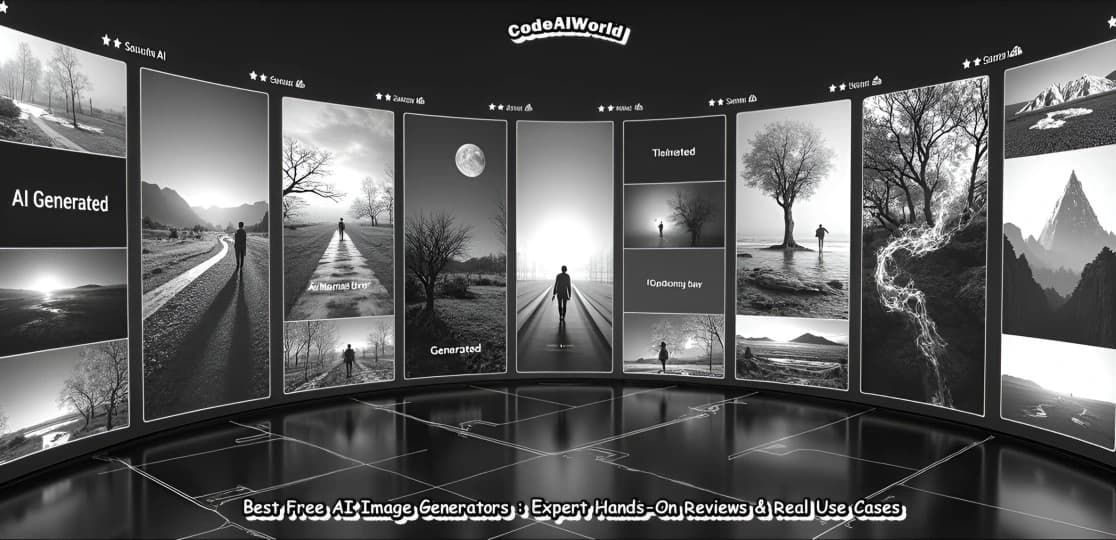
Best Free AI Image Generators : Expert Hands-On Reviews & Real Use Cases
Discover the best free AI image generators in 2026 with this expert hands-on guide. Explore real user experiences, tool comparisons, and personal tips for top platforms like Leonardo AI, DALL·E 3, Adobe Firefly, Playground AI, and Ideogram perfect for bloggers, marketers, designers, and everyday creators.
- Published on
- /2/5/7 मिनट पढ़ें/1497 देखा गया
इस पृष्ठ पर
- Introduction
- Why use ai image generators
- My top free ai image generators first-person experiences
- Leonardo ai free tier
- Dalle 3 openai
- Adobe firefly free version
- Playground ai best for versatile image creation amp quick experiments
- Other notable free options
- Tips amp best practices for ai image generation
- Practical use cases amp examples
- Conclusion
Introduction#
Introduce the rise of AI image generators and why they matter for bloggers, marketers, designers, and content creators.
Mention your perspective as an AI and photography enthusiast sharing a personal journey with these tools.
Highlight the promise of “free” – many powerful image generators now offer free tiers or credits for anyone to try.
Why Use AI Image Generators?#
Time-saving & Custom Visuals: Quickly create unique images without spending hours in Photoshop or searching stock libraries.
Boost Creativity: AI can spark new design ideas or generate visuals that might be hard to find or shoot.
Accessibility: Many tools are web-based or easy to use, letting non-designers produce professional-looking images.
Versatility: From blog headers and social media graphics to concept art, AI tools adapt to different needs.
My Top Free AI Image Generators (First-Person Experiences)#
This section will cover the main tools I’ve personally used and recommend. For each, I’ll share what it does, how I use it, and tips for getting the best results.
Leonardo AI (Free Tier)#
Overview: A versatile AI art generator offering a generous free plan. I’ve used Leonardo AI to create blog illustrations and marketing visuals. It’s known for detailed outputs and many style options.
Personal Use-Case: “I used Leonardo AI to design custom graphics for a recent blog post. By tweaking the text prompt and style filters, I got an image that fit my site’s vibe in minutes.”
Strengths: High image quality, many artistic filters, and fine-grained control over details. (Great for concept art and stylized images.)
Limitations: Free credits are limited each month, so for heavy use you may need to replenish or switch tools.
DALL·E 3 (OpenAI)#
Overview: OpenAI’s DALL·E 3 (accessible via ChatGPT) produces impressively creative text-to-image results. I often use the free prompts available through my ChatGPT Plus subscription or limited free trials.
Personal Use-Case: “I created a set of social media post images with DALL·E. Its AI understood complex prompts (like ‘vintage travel poster style’) and generated stunning, original artwork.”
Strengths: Excellent at following detailed prompts, generating realistic textures, and integrating text (like signs in the image) quite accurately.
Limitations: Free usage is limited (you get a fixed number of credits), and the quality can vary. Sometimes I had to refine prompts or try several times.
Adobe Firefly (Free Version)#
Overview: Adobe’s generative AI – Firefly – offers a free tier that’s great for designers. Integrated with Creative Cloud, it uses realistic models for text-to-image, plus features like text effects and inpainting.
Personal Use-Case: “In my design workflow, I used Adobe Firefly to generate background images for marketing flyers. The tool’s Adobe integration made it easy to import these AI images into Photoshop for final tweaks.”
Strengths: High-quality, polished results; safe content filters; works well with design tools; includes text effects and vector image generation.
Limitations: Requires an Adobe account. The free plan has limited renders per month, and advanced features may require paid subscription.
Playground AI : Best for Versatile Image Creation & Quick Experiments#
Overview: Playground AI is a powerful, beginner-friendly platform that lets you create images using Stable Diffusion models and other AI technologies. What I love about Playground AI is its flexibility—you can explore different styles like photorealism, anime, or digital art, and it doesn’t overwhelm you with complex settings right away.
Personal Use-Case: "I’ve often turned to Playground AI when I need fast visuals for blog thumbnails or Instagram posts. Its intuitive interface makes it easy to generate clean, aesthetic images without a lot of tweaking. I especially like using it for experimental designs, like testing futuristic or vaporwave styles for my posts."
Strengths: Generous free tier (with limited daily image generations).Offers multiple models and artistic styles. Beginner-friendly with an easy-to-use dashboard and prompt options. Good for experimenting with various aesthetics and visual concepts.
Limitations: Limited advanced customization compared to some pro-grade tools. Free credits can get used up quickly if you generate a lot in one go. Some image outputs may look generic without detailed prompts.
Other Notable Free Options#
Stable Diffusion Interfaces: Open-source models like Stable Diffusion power many free sites (e.g., Hugging Face, StableStudio). These often give more control (e.g., setting seed, prompts). I tried a free Stable Diffusion web interface to get specific fantasy-art styles.
Special Mentions: Craiyon (formerly DALL·E Mini) – totally free and simple, though the image quality is basic. Good for kids or quick mock-ups. Other tools: For completeness, I’ll mention apps like Midjourney (paid, but sometimes free trials) or DeepAI, but I’ll focus on truly free options in detail.
Tips & Best Practices for AI Image Generation#
Crafting Effective Prompts: Be clear and descriptive. Include style cues (e.g., “oil painting,” “fantasy landscape”) or reference artists if allowed. I often start with a simple prompt and refine it based on the AI’s output.
Use Reference Images: If the tool allows (e.g. some Stable Diffusion UIs), upload a reference photo or sketch. This helped me match a specific color scheme or composition.
Iterate and Combine: Don’t settle on the first result. I try multiple variations and sometimes combine elements (like merging two good outputs in Photoshop).
Post-Editing: Use basic photo editors (even free ones like GIMP or Canva) to crop, adjust colors, or touch up details. AI images sometimes need minor fixes or text overlays for captions.
Mind the Limits: Keep track of free credits. For example, DALL·E gives a finite number of free generations each month, and Leonardo AI limits per day. I plan projects accordingly or try a different tool once I hit a limit.
Stay Ethical: Use AI art responsibly. For public use (blogs, marketing), ensure you have the right to use the images and consider adding alt text (“AI-generated image of…” if transparency is needed). Avoid generating copyrighted characters or using images in misleading ways.
Practical Use Cases & Examples#
Blog Illustrations: I generated feature images for blog posts, ensuring the visuals matched the article’s theme. For example, an article on travel got an AI-created mountain vista background.
Social Media Graphics: Quickly making shareable visuals (quotes on AI-generated backgrounds, or product mock-ups). I saved time by generating base images and adding text overlays.
Marketing Materials: Designing flyer or ad graphics with unique elements (like abstract shapes or futuristic designs) that stand out more than stock photos.
Art & Concept Sketches: Sketching out ideas before manual editing. AI images gave me a starting point for colors and composition which I then refined.
Conclusion#
Summarize personal top picks (e.g., “In my experience, Leonardo AI, DALL·E 3, and Adobe Firefly stood out as the best free options”).
Emphasize that each tool has its strengths, so the best choice depends on the project (photo-realism vs. cartoon style, credit limits, etc.).
Encourage readers to try multiple tools – even combining them – to see what works best.
Note that AI image generation is rapidly evolving. By 2025, these free tools are already powerful, and future updates will only get better. Stay curious and experiment!
💬 Have questions or feedback? Drop a comment below and let's discuss! 🚀